A note before we get into it. I am not writing this as a policy expert or a spokesperson for anyone. I’m writing it as someone doing this job every day, hearing the same frustrations from residents over and over, and dealing firsthand with the gaps this post describes.
I have learned a lot in this role, sometimes the hard way. Much of what I know came from experienced ACOs who took the time to share it. That kind of informal mentorship matters more than it should, which is itself part of the problem. The knowledge exists. The structure to reliably pass it on does not.
I am not raising these issues to tear anything down. The people doing this work, including the state staff who support it, are largely doing the best they can within a framework that was not built to succeed. What I want is an honest conversation about where that framework needs to change. Residents deserve better coverage than the current system reliably delivers, and most people in this field would agree.
These are my observations. If you have thoughts, experience, or ideas on any of this, I am genuinely interested. Reach out at brandon@oxfordaco.com.
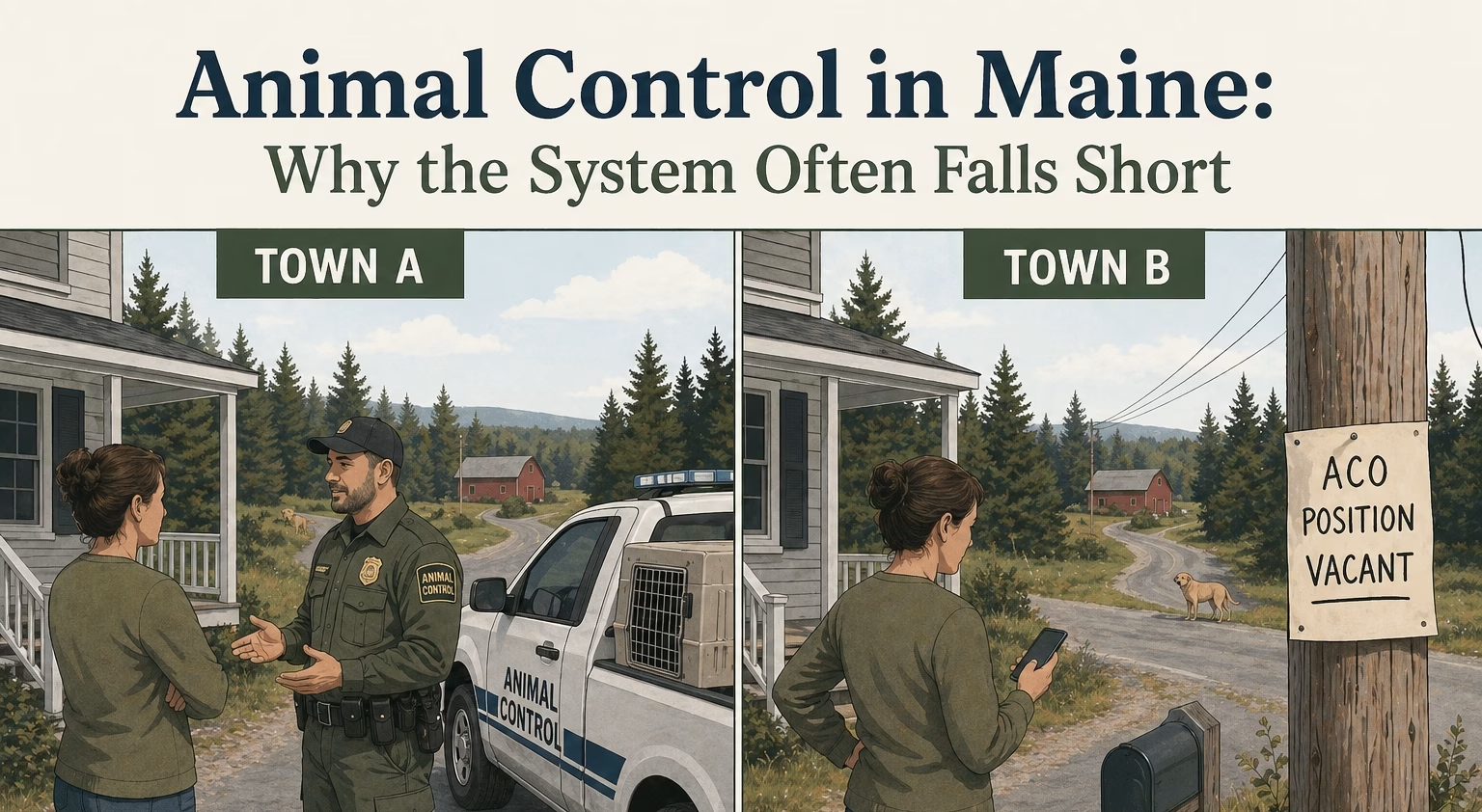
Maine law requires every municipality to provide animal control coverage. That sounds simple. In practice, the system has enough gaps that residents across the state end up with unreliable coverage, inconsistent enforcement, or no one to call at all.
This post does not point fingers at any individual officer or town. It explains how the system actually works and why outcomes vary so much depending on where you live.
The Mandate With No Money Behind It
Maine Title 7 requires every municipality to designate an Animal Control Officer. The state provides zero funding to support that requirement. Towns figure out how to pay for it entirely on their own.
For most rural towns, that means a part-time position with low pay. Towns treat it as a line item to minimize rather than a service to invest in. When the position gets hard to fill, residents feel it directly.
496 Towns, No Reliable Count of Who Is Actually Covered
Maine has 496 municipalities. All of them must have an ACO. How many actually have coverage at any given time is hard to answer, because no one reliably tracks it.
The law requires municipal clerks to notify the commissioner when a position goes vacant. But that notification triggers no follow-up. Nobody at the state level ensures the town fills the role. Some towns go without coverage. Others share an ACO already stretched across multiple jurisdictions.
No Requirement for After-Hours Coverage
Maine statute does not require a town to make an ACO available evenings, weekends, or holidays. Many rural ACOs work part-time by design. A resident dealing with a bite incident or a welfare concern on a Saturday night may reach nobody. The law says towns must have an ACO. It says nothing about when that person needs to be available.
No Equipment, Vehicle, or Shelter Standards
Towns do not have to provide dedicated equipment, a proper vehicle, or a shelter agreement. Some ACOs work entirely out of a personal vehicle with no budget behind them. When there is nowhere to bring an impounded animal, the ACO’s legal options shrink fast regardless of what the situation calls for.
No Minimum Availability or On-Call Requirement
Maine law sets no floor for how many hours per week an ACO must be reachable. A town can satisfy the mandate with someone who works minimal hours and rarely picks up the phone. What “having an ACO” means in practice varies enormously town to town.
Six Months to Get Certified, No Real Deadline After That
Maine gives a new ACO six months to complete the state certification course. That window is reasonable. What happens after it closes is where the gap shows up.
When an officer misses the six-month window, nothing automatic happens. The town faces no penalty. The officer keeps working. The requirement exists on paper, but following up on it depends on someone actually doing so.
If a certified officer later lets their continuing education lapse, they must retake the entire certification course to get it back. That sounds like accountability. In practice, lapsed officers often keep working while nobody formally tracks their status.
The State Trains ACOs But Has No Say in Hiring or Firing
The Maine Animal Welfare Program runs ACO certification and training. It does not participate in hiring or personnel decisions. The state can train whoever a town sends. It cannot tell a town to hire someone more qualified or remove someone who is not performing.
The quality of animal control in any given town depends almost entirely on who the Select Board or town manager put in the role, and whether that person stays long enough to actually learn the job.
The Training Gap Between ACOs and Humane Agents
State Humane Agents must complete a 100-hour training program at the Maine Criminal Justice Academy. They also complete a minimum of 40 hours of continuing education every year.
ACOs must complete an online certification course within six months and 8 hours of continuing education per year after that.
Both roles handle animal welfare situations. The gap in required preparation is significant. This is not a knock on individual ACOs. Many bring years of experience and genuine commitment. The problem is structural, not personal.
Shared Coverage Arrangements Have No Framework
Towns can share an ACO. Maine law provides no structure for how that works. No statute addresses which town gets priority when calls overlap, how response obligations divide between towns, or what happens when a shared officer hits capacity. Towns work it out informally, or they don’t.
No Standardized Reporting or Case Tracking
No statewide system tracks ACO activity, case outcomes, or response times. Each town handles records differently. Some keep detailed logs. Others keep very little. This makes it nearly impossible to spot patterns of poor coverage or build any accountability record from actual performance data.
If a resident wants to know how their town’s animal control program is performing, no central place exists to check.
Statutes That Define Rules Without Attaching Consequences
Some Maine animal control statutes define what an ACO can or cannot do without specifying what happens when they get it wrong. The law sets the standard. It does not always set the penalty for missing it.
Compliance depends on the individual. An experienced officer follows the statute because they understand it. An undertrained officer may handle the same situation differently, and no formal mechanism may exist to address that.
Where Complaints Go and What Happens to Them
Complaints about an ACO go in writing to the town that employs them. Most ACOs report to the town clerk or the police department, but this varies.
That process has a structural problem. The Select Board or town manager reviewing the complaint is the same body that hired the ACO and sets their pay. That is not an independent review. The outcome depends heavily on how seriously local officials take it.
§3950-A: The Accountability Statute and Why It Rarely Gets Used
Maine has a statute covering what happens when an ACO or municipal official neglects their duties. Title 7 §3950-A, Official Refusal or Neglect of Duty, sounds more powerful than it is.
Under §3950-A, an ACO commits a civil violation by refusing or intentionally failing to perform their required duties. The fine runs between $50 and $500. The state can also revoke certification. The commissioner must investigate when someone submits a written complaint.
Here is where it breaks down.
The statute requires intentional refusal or neglect. An officer who misapplies the law or handles a situation incorrectly does not automatically meet that bar. Incompetence is not intentional neglect, and that distinction matters.
The maximum fine is $500. For a civil violation involving a mishandled bite report or an unaddressed welfare situation, that consequence is minimal.
Most residents do not know this statute exists. They do not know a written complaint triggers the investigation process. And once they submit one, no clear follow-up path exists.
The mechanism is real. But a high intent threshold, a low penalty ceiling, and a process most people cannot navigate mean it rarely gets used and even more rarely produces meaningful accountability.
What People Think the Law Covers vs. What It Actually Does
Most residents assume Maine’s animal control laws are stronger than they are. People expect an ACO to remove an animal on the spot, issue immediate consequences, or resolve a situation the same day. The law often does not support that.
Maine’s animal control statutes set a floor. They define minimum requirements and basic authority. They are not a comprehensive enforcement toolkit. An ACO can clearly see a problem and still have very limited legal options to act on it right away. That gap between expectation and reality creates frustration on both sides.
What You Can Do
A frustrating experience with animal control in Maine may reflect a systemic problem rather than just an individual failure. That does not mean every bad outcome is the system’s fault. Personal accountability still matters. The situation is just more complicated than it looks.
Document animal control issues. Follow up in writing when a situation was not handled correctly. If the town is not responding, submit a written complaint to the Maine Animal Welfare Program at animal.welfare@maine.gov or call 1-877-269-9200.
For questions about how something was handled in my service area, reach me through Oxford County Dispatch at 207-743-9554, Option 0.
For more on Maine animal control law, visit the Animal Control FAQ or the Maine Laws section of this site.
How Residents Can Push for Change
The gaps in Maine’s animal control system are not inevitable. They are the result of policy choices, and policy choices can change.
If you want better coverage in your town, the most direct path runs through your local government. Show up to Select Board meetings. Ask specifically what the town budgets for animal control, whether the current ACO is certified, and what the coverage plan is for evenings and weekends. Most residents never ask these questions. Towns that face no pressure to improve rarely do.
At the state level, the Legislature’s Agriculture, Conservation and Forestry Committee has jurisdiction over animal welfare law. If you believe the certification requirements, funding structure, or accountability mechanisms need strengthening, contact your state representative or senator. Bills that improve animal control standards have to start somewhere. Find your legislators at legislature.maine.gov.
The Maine Animal Welfare Advisory Council is another avenue worth knowing about. The council advises the commissioner on animal welfare policy, reviews training programs for ACOs and Humane Agents, and makes recommendations on proposed changes to the law. Council meetings are open to the public. Attending or submitting written comment puts specific concerns directly in front of the people who advise on how this system gets shaped.
Self-education matters too. Maine’s animal welfare statutes are publicly available at legislature.maine.gov. If something about how a situation was handled does not seem right, look it up. If you cannot find a clear answer in the statute, the Maine Animal Welfare Program is a legitimate resource and reaches at animal.welfare@maine.gov or 1-877-269-9200. You can also ask your local ACO directly. Most are willing to explain the law and how it applies.
You can also support organizations that advocate for animal welfare policy in Maine. Groups like the Maine Animal Coalition work on legislative issues affecting animals and the systems meant to protect them.
The system works better where communities demand that it does.